









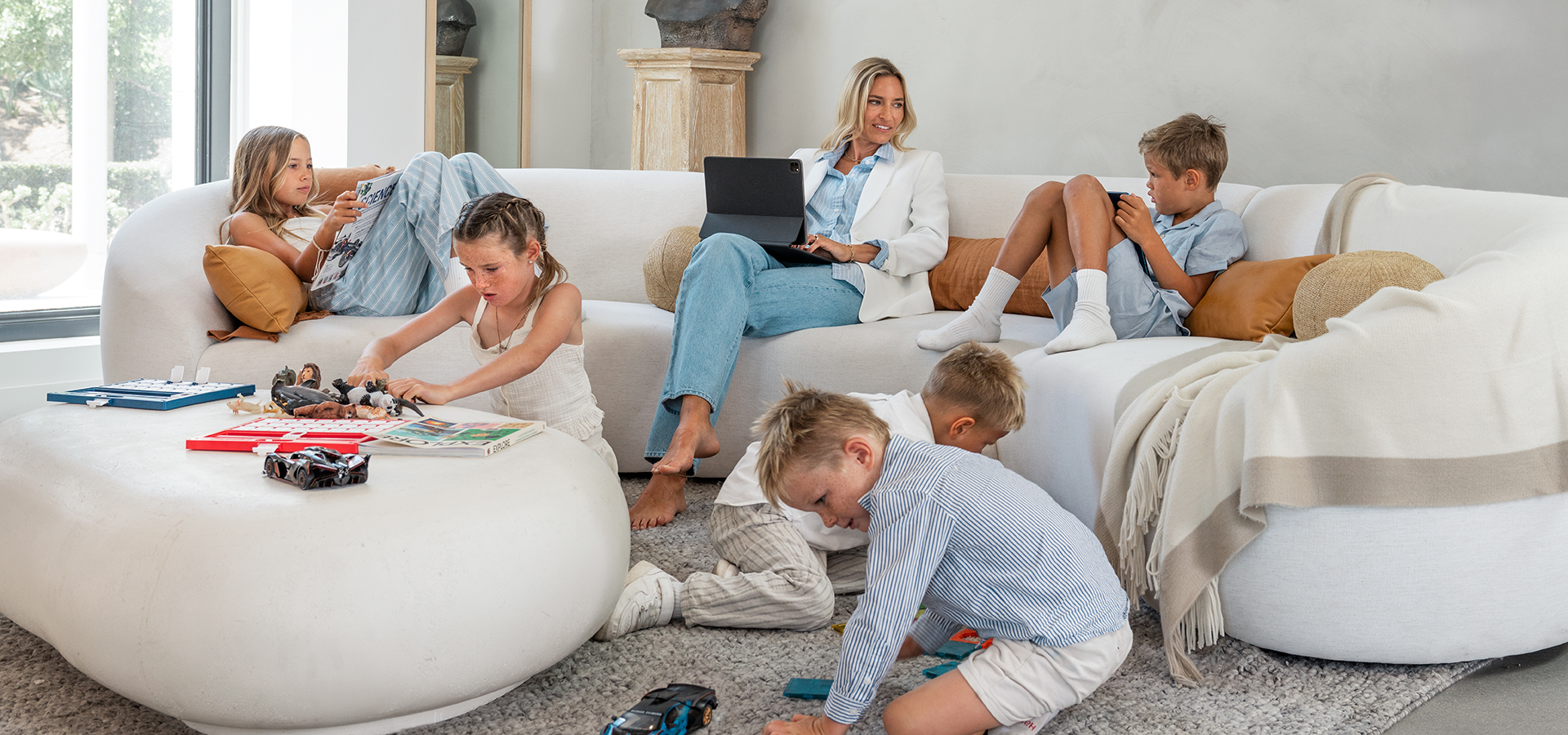
Hope Schneider is surrounded by five children … and a beautiful kind of chaos. Someone needs something, someone is laughing, someone is climbing onto her lap. In the middle of it all, Hope remains remarkably present—not standing alone as the polished co-founder and co-CEO of footwear company Wolf & Shepherd, but surrounded by the five little humans who are every bit as much a part of her story.

She looks like a woman who has it all: beautiful, accomplished and intelligent. A former collegiate track captain and conference champion in the 800-meter race, she earned a master’s degree in sports science and then coached collegiate athletes. She even ran an ultramarathon across the Kalahari Desert.
Today, she is raising five children while leading the company she built alongside her husband, Justin Schneider. Yet Hope dismantles the illusion that any of it happens effortlessly.
“It’s truly not possible to really have it all,” she says, admitting that she doesn’t exercise as much as she would like, and her social life is smaller because she is adamant about protecting her sleep. Hope prioritizes family and work, and often—after the children are asleep—she and Justin open their computers again.
“There’s a reality of running this business; it’s not that pretty,” she says.
Perhaps that is what makes Hope’s story so compelling: She knows what matters. And that understanding began long before marriage, children and Wolf & Shepherd.
Hope grew up outside Cleveland, the oldest daughter in a bustling Midwestern Irish Catholic family of eight children. They weren’t wealthy. Her father worked, her mother stayed home and much of the family’s resources paid for the children’s private-school education.
“She was like, ‘I’m gonna be the best mom ever.’ That was her career,” Hope says of her mother, who ran that large household with such capability that Hope still calls her for business advice today. “She is a shark!”
Those Midwestern values—family, faith, humility and hard work—are deeply embedded in the life Hope and Justin have created.
“There’s this realness to her.”
As a teenager, Hope made music videos and commercials, recruiting her siblings as her cast, then filming, directing and editing everything herself.
“I really enjoyed building something and creating something from scratch,” she remembers. “I wasn’t watching TV; I was making stuff.”
Sports added a layer of discipline and a desire to do something well. Justin, who is also a former collegiate athlete, recognized that drive immediately. But he also saw something softer. People, particularly women, always gravitated toward Hope, he says. Leadership seemed to find her, rather than the other way around.
The two first crossed paths through collegiate track and then reconnected years later. By 2013 Justin was brainstorming ideas for a company, and in 2014 he began sourcing and manufacturing what would become Wolf & Shepherd. Hope helped shape the framework of the fledgling brand. They married in 2015, and Wolf & Shepherd shipped its first product that June.
Stella arrived in March 2016, and Hope left coaching to join the business full time. From there, the Schneider family timeline and the Wolf & Shepherd timeline become almost impossible to separate.
Babies arrived as products launched. Houses and warehouses expanded. Their marriage, family and company were all being built simultaneously.
The early days were decidedly unglamorous. Hope remembers taking baby Stella to their warehouse and putting a Pack ’n Play in the bathroom because it was dark enough for her to nap. Then Hope and Justin “worked, worked, worked.” At the end of the day, they loaded customer orders into their Prius and drove them to the post office.
Justin is adamant that the perception of Wolf & Shepherd being only his business is wrong. “The company objectively is stronger and more secure with Hope in leadership,” he says. And he rejects the notion that he somehow gave his wife space at the table: “She commanded it.”
He jokes about the inevitable question of which one is the wolf and which is the shepherd. “I’m a sheep in wolf’s clothing, and Hope is a wolf in sheep’s clothing,” he says. “She’s far fiercer.”
That juxtaposition feels exactly right. Hope is warm, grounded and remarkably humble. But underneath is the athlete—the woman who competes, perseveres and gets things done. Justin says Hope never set out to conquer the corporate world or become the face of a company. Instead, her abilities kept pulling her further into leadership.

When Wolf & Shepherd relocated its headquarters to Los Angeles and the South Bay in 2017, the Schneiders found a community that reflected many of the values they were building their lives around. Their children attend school here, they go to church here, and they have built deep friendships here. Hope has found herself particularly inspired by the women surrounding her.
She remembers initially assuming many of the mothers she encountered at school drop-off were stay-at-home moms, only to discover that one was a television anchor, another had built a successful startup and another traveled the world for work.
“And they still pick up their kids,” she says. “I thought I was special, but I realized this is the norm around here. This is standard. These people are bad-asses, which is inspiring.”
Hope is, in many ways, reflective of the women in this community: women building businesses and raising children, showing up professionally and still showing up at school pickup, whose extraordinary accomplishments may not be apparent when you pass them on The Strand.
And perhaps living among those women also helped Hope articulate something she had been wrestling with herself: Why must women choose?
As Wolf & Shepherd grew, Hope began questioning what the company stood for beyond selling shoes. She understood intimately the tension women feel—the working mother wondering whether she is present enough at school and the mother at school wondering whether she should be accomplishing more professionally. That conversation helped inspire a philosophy central to Wolf & Shepherd: work-life blend rather than work-life balance.
It also informed Hope’s vision for the company’s women’s collection. When she began imagining the Wolf & Shepherd woman, she wrote about someone striving to be the best mother, sister, wife and daughter she can be. Someone who wants to do things well but understands she will never do them perfectly.
“There’s this realness to her,” Hope says. It is difficult not to hear Hope describing herself.
She is clear that her career is possible because she does not raise five children alone. “The amount of work Justin does at home is mind-blowing,” she says.
Their partnership extends into the company. They respect one another’s strengths, challenge each other and return to something wonderfully simple. “We’re on the same team,” Hope says.
That brings us back to the image of Hope surrounded by her five kids. Not a portrait of perfection but one of family, faith, partnership, ambition, compromise, community and love.
Hope proves that women can decide what winning looks like for themselves. Women can be ambitious and maternal, powerful and playful, competitive and deeply nurturing. They can build something meaningful and still make school pickup, lean on their partners and let some things go without losing themselves.
Perhaps the fullest life isn’t one in which we manage to hold everything; it is one in which we know exactly what is worth holding on to.